


Apple HomeView Accessories Turn the Smart Display Into a Command Post
Apple’s upcoming HomeView ecosystem is transforming the static home hub into a modular platform, leveraging robotic mounts and Apple Intelligence to rival Echo Show.
8 min read

TL;DR Apple is turning its long-rumored smart display into a modular hardware ecosystem dubbed HomeView, pairing a square-format command screen with motorized bases, sensor pucks, and on-device Apple Intelligence to challenge Amazon and Google’s domestic dominance.
For nearly a decade, the smart home has suffered from a profound lack of imagination. You bought a smart speaker, realized it was great for kitchen timers and mediocre for music, and perhaps graduated to a smart display—a glorified digital photo frame that occasionally served up recipe cards and ring doorbell feeds before spamming you with sponsored headlines.
Apple watched that stagnation unfold from the sidelines. Aside from the HomePod and Apple TV acting as silent Thread border routers, Cupertino has treated home hardware as a peripheral hobby.
That complacency is officially over. With the unveiling of Apple’s dedicated home platform—informally referred to across supply chains as HomeView—Apple isn’t just launching an iPad glued to a speaker. Newly published MFi (Made for iPhone/iPad/Home) developer specifications and internal component leaks reveal a modular ecosystem of magnetic docks, motorized tracking mounts, and context-aware sensor nodes. Instead of selling a single, monolithic countertop screen, Apple is turning the smart home hub into an adaptable, distributed hardware stack.

Beyond the Slab: The Modular Accessory Architecture
The core of HomeView is an uncharacteristically practical piece of hardware: a roughly six-inch, squared-aspect display running a specialized derivative of tvOS codenamed “homeOS.” It features an ultra-wide FaceTime camera, front-facing ambient light sensors, and an edge-to-edge magnetic backplate reminiscent of MagSafe, augmented by high-throughput pogo pins dubbed the Smart Base Connector.
Rather than packing heavy amplifiers, motorized actuators, and bulky power supplies into the main display panel, Apple has offloaded them into a lineup of interchangeable accessories. The display unit itself is lightweight, portable, and battery-buffered, meaning users can detach it from a kitchen mount and carry it to the patio for an hour of control or media streaming.
The real ambition lies in the accessories engineered to dock with it:
- The Motorized Studio Base: A cylindrical speaker stand featuring silent brushless motors capable of 360-degree panning and 70-degree tilting. Powered by Apple Intelligence vision models running on the display’s A18 silicon, the base physically tracks users as they move around a room during FaceTime calls or cooking sessions.
- The Ambient Sound Dock: A stationary audio wedge designed to mirror the acoustic performance of the HomePod mini, transforming the HomeView panel into a premium tabletop stereo unit.
- The Flush Wall Plate: A hardwired sub-plate that replaces standard light switches or thermostat boxes, letting the HomeView sit flush against drywall while drawing constant low-voltage direct current.
- Satellite Sensor Pucks: Battery-operated environmental nodes measuring micro-climate metrics, mmWave presence detection, and ambient light, feeding granular room data back to the hub.
By separating the computing unit from the physical mounting infrastructure, Apple bypasses the single biggest flaw of existing devices like the Amazon Echo Show 10 and Google Nest Hub Max: acoustic and mechanical obsolescence.
| Hardware Feature | Apple HomeView (Motorized Bundle) | Amazon Echo Show 10 (3rd Gen) | Google Nest Hub Max |
|---|---|---|---|
| Form Factor | Modular detach-screen + robotic dock | Fixed motorized pedestal display | Fixed wedge display |
| Primary Compute | A18 (Edge Neural Engine) | MediaTek MT8183 + AZ2 Neural Edge | Amlogic S905D2 + Google Edge TPU |
| Local Intelligence | On-device personal context LLM + Vision | Cloud-reliant Alexa LLM | Cloud-reliant Gemini Assistant |
| Connectivity | Thread, Matter, Wi-Fi 6E, Ultra-Wideband | Thread, Zigbee, Matter, Wi-Fi 6 | Thread, Matter, Wi-Fi 5 |
| Privacy Architecture | Secure Enclave, on-device vision processing | Cloud processing with manual shutter | Hardware camera/mic kill-switch |
Apple Intelligence at the Countertop: Vision Without Surveillance
Hardware means nothing in the ambient computing era without an interface that feels intuitive rather than invasive. Smart displays from rival platforms have historically struggled with privacy trust; consumers remain uncomfortable placing motorized, wide-angle cameras in their private living quarters when feeds frequently interact with cloud servers.
Apple is leveraging its edge-compute architecture to flip that narrative. HomeView relies entirely on local models processed on the A18’s Neural Engine. The camera does not upload video to iCloud for person recognition or gesture tracking. Instead, it processes spatial geometry directly on the silicon, passing structured metadata to homeOS.
This powers what engineers call Contextual Proximity UI. When you are across the room, the HomeView screen displays large, high-contrast glanceable information: the outdoor temperature, the status of the security system, and family calendars. As you step within three feet, the camera registers your presence—identifying which family member is approaching via local facial vectors—and dynamically scales the interface down to show personal reminders, unread messages, and fine-grained media controls.
When evaluating ambient gadgets, maintaining rigorous standards for data security is the difference between an indispensable home assistant and a corporate wiretap. Apple’s architecture ensures that biometric vectors never leave the local hardware sandbox, adhering to consumer protection frameworks outlined by the Federal Trade Commission regarding household sensor safety.
Furthermore, HomeView introduces off-axis gesture control. By combining mmWave presence sensors embedded in the dock with the camera’s low-power peripheral vision, users can silence timers, adjust audio volume, or dismiss intercom notifications with a wave of a hand from across the kitchen counter, even when their hands are covered in flour or water.
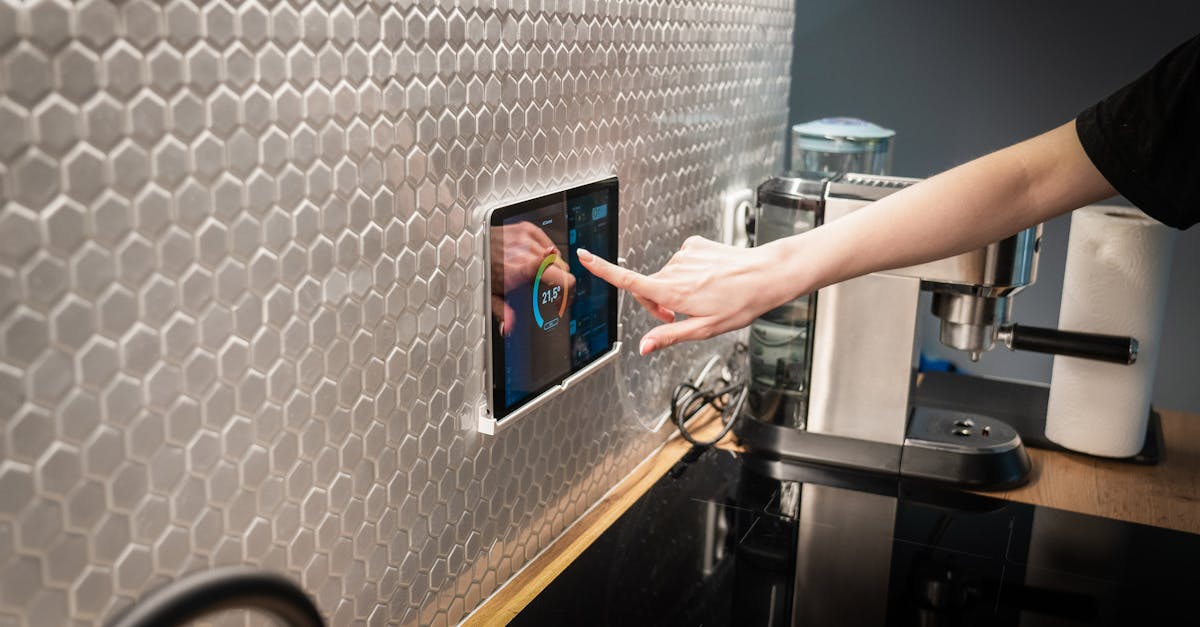 hands-free gesture control interface showing smart home kitchen scene — Photo by Jakub Zerdzicki on Pexels
Third-Party MFi Expansion: The New Living Room Economy
Apple knows it cannot manufacture every mount, bracket, and specialized interface itself. The true potential of HomeView lies in the opening of its Smart Base Connector specifications through the MFi program, a strategy that is already mobilizing major third-party manufacturers.
Longtime partners like Belkin, Eve Systems, and Logitech are readying a wave of specialized peripherals designed around Apple’s docking standard:
- Kitchen Cabinet Sub-Mounts: Drop-down, magnetic brackets that suspend the HomeView panel beneath upper cabinetry, freeing up precious kitchen counter real estate while charging the screen continuously.
- Under-Bed Motion Arrays: Sensor runners that interface directly with HomeView’s Thread radio, automating subtle path-lighting when family members get up at night without needing cloud verification.
- Hi-Fi Acoustic Enclosures: High-end audio companies are prototyping audiophile-grade shelf systems that use the HomeView panel simply as a high-resolution touch controller and streaming transport.
As the industry converges around modular computing interfaces, understanding the trajectory of future tech means recognizing that screens are becoming disposable, interchangeable windows into centralized home operating models. By delegating mounting, sound, and specialized ergonomics to third parties, Apple replicates the wildly profitable iPhone accessory playbook within the domestic interior.
Developers building apps for homeOS aren’t just making phone interfaces bigger; they are tapping into the Matter standard via Apple’s modernized APIs, creating specialized dashboards for solar inverter monitoring, HVAC zoning, and vehicle telemetry.
Matter 1.4 and the Protocol Battlefield
The timing of Apple’s HomeView push is no coincidence. The rollout of Matter 1.4 by the Connectivity Standards Alliance has addressed long-standing pain points in smart home infrastructure: multi-admin synchronization, enhanced home energy management, and complex presence sensing.
Historically, Apple Home suffered because its strict security and licensing rules alienated budget accessory makers. Matter leveled the playing field, making cross-brand integration standard. Yet HomeView reveals Apple’s defensive maneuver: make the accessories standard via Matter, but make the orchestration inimitable via proprietary hardware integration.
While any cheap Matter-compatible smart plug or blind will connect seamlessly to HomeView, the advanced contextual automation—such as panning the camera when a robot vacuum approaches or switching lighting profiles based on who is standing in front of the screen—remains tightly integrated within Apple’s ecosystem.
This hybrid approach allows Apple to capitalize on the vast catalog of affordable third-party IoT hardware while keeping the premium control layer—and the associated accessory margins—strictly within the MFi ecosystem. It’s a compelling balance for consumers who rely on cross-platform accessories but want the polish of Cupertino’s software engineering.
The Reality Check: Can Apple Win the Countertop?
Despite the architectural elegance of HomeView’s modular design, Apple faces friction points that hardware specifications alone cannot resolve.
First is pricing psychology. Amazon and Google have spent years conditioning the public to treat smart displays as disposable, sub-$100 impulsive holiday purchases. If Apple’s detached HomeView panel retails near $249, with motorized bases and specialized docks adding another $150 to $200, the entry barrier will remain steep for casual smart-home adopters.
Second is the historical baggage of Siri. While on-device Apple Intelligence has fundamentally revitalized the assistant’s contextual comprehension on iPhones and Macs, its performance inside shared family environments remains a work in progress. Smart displays must juggle multi-user voice isolation, conflicting personal calendars, and cross-talk from loud televisions—challenges that even sophisticated ai apps struggle to navigate in real-world spaces.
Yet, Apple has a distinct structural advantage that its competitors lack: an installed base of billions of personal devices that already synchronize context, biometrics, and media seamlessly. If HomeView succeeds, it will not be because it is a superior smart display. It will be because Apple stopped treating the home as a room full of disconnected gadgets and began treating it as a modular, personal computing environment.
Last updated Oct 14, 2026
Newsroom
Reporting and analysis from the InnotechInsider editorial team, covering the technology shaping tomorrow.
Related stories

Apple's October Playbook: M5 Macs, OLED Tablets, and the AI Gambit
Following its September iPhone 18 showcase, Apple is prepping an aggressive October hardware drop centered on M5 silicon and sweeping Mac and iPad upgrades.

iOS 27 Beta Lands: A Conversational Siri, Liquid Glass Tweaks, and Fold-Ready Multitasking
Apple's first iOS 27 developer beta finally gives Siri a real conversation, adds AI photo tools, and quietly preps the iPhone for a folding future.

AT&T Warns iPhone 18 Pro Max Owners of Network Flaw: Update Now
AT&T has issued an urgent bulletin urging iPhone 18 Pro Max buyers to patch their devices immediately following widespread cellular dropouts on 5G Advanced.