


Celebrities, Silicon, and the Strange Death of the Tech Keynote
Google brought in Trevor Noah to sell its latest AI smartphone. When consumer silicon hits a wall, late-night humor becomes the ultimate feature mask.

TL;DR Google hired comedian Trevor Noah to anchor its flagship Pixel unveiling, signaling a crucial shift in consumer electronics: when hardware leaps become microscopic and software updates happen continuously in the cloud, tech giants must rely on pure entertainment to make an annual product launch feel like an event.
There was a time when a Silicon Valley product keynote was an exercise in solemn engineering evangelism. An executive in a dark turtleneck or a neatly pressed button-down would step onto a brightly lit stage, click through a deck of minimalist slides, and deliver technical metrics to a room full of rapt journalists. We marveled at nanometer shrinkages, megapixel jumps, and RAM bandwidth.
Then came Google’s latest launch event, where comedian Trevor Noah was brought in to host the reveal of the company’s new hardware ecosystem.
Seeing a former host of The Daily Show poke fun at battery anxiety and AI hallucinations while introducing a flagship smartphone wasn’t just a quirky marketing choice—it was a confession. The era of revolutionary annual smartphone hardware upgrades is officially dead. In its place, tech titans have built a new promotional architecture powered by celebrity charisma, self-deprecating comedy, and algorithmic promises. When the silicon under the glass only improves by single-digit percentage points year over year, late-night humor becomes the ultimate product mask.
1. The Charisma Buffer: Why Big Tech Needs Late-Night Stars
For over a decade, consumer technology companies relied on what industry analysts called “the demo effect.” You showed a device doing something visually impossible—pulling a computer out of a manila envelope, scrolling through album art with a fluid thumb swipe, or rendering dark landscapes in pitch-black light—and the product sold itself.
Today, those visual leaps are gone. The physical form factor of the premium smartphone has hit an evolutionary dead end. It is a glass-and-aluminum rectangle with a camera bump on the back and a high-refresh-rate OLED panel on the front. When your primary hardware highlight is a 10% boost in thermal efficiency or slightly refined bezel symmetry, asking a software VP to spend fifteen minutes dissecting memory controllers risks turning a multi-million-dollar live stream into an inadvertent sleep aid.
Enter the Charisma Buffer. By placing an experienced stand-up comedian at the podium, Google masterfully altered the psychological contract with the audience.
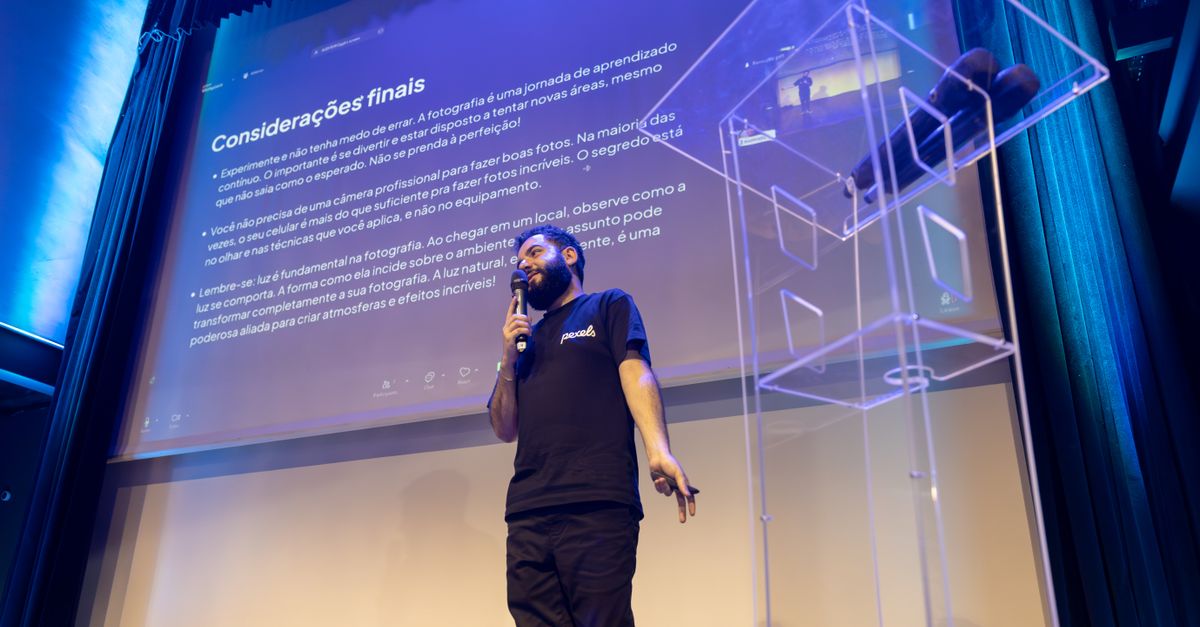 professional television presenter holding a microphone on an illuminated stage at a technology conference — Photo by Matheus Bertelli on Pexels
When Noah jokes about how many photo editing features we actually use versus how many we just play with while sitting on the couch, he disarms the skeptic. The host acknowledges the absurdity of spending nearly a thousand dollars on incremental updates before the viewer even has time to point it out in a live chat comment. Humor neutralizes cynicism, converting what would be a dry corporate presentation into an entertainment special.
2. The Silicon Wall Meets the Upgrade Plateau
The shift toward Hollywood-style hosting isn’t happening in a vacuum; it is driven by hard physical limits. The microchip industry is staring down severe thermodynamic constraints. As semiconductor manufacturers push toward sub-2-nanometer fabrication processes, heat dissipation and power consumption become existential bottlenecks.
According to technical documentation published on Google Tensor architectures, modern System-on-Chip (SoC) design is no longer about raw CPU clock speeds. Instead, it revolves around dedicated Neural Processing Units (NPUs) engineered specifically for machine learning inferencing. But while NPUs are essential for background operations, they don’t offer the immediate visual impact of a high-resolution display or a dramatic camera upgrade.
To understand why keynotes have surrendered technical deep-dives to scripted comedy, consider how the focus of flagship smartphone reveals has fundamentally migrated over the last fifteen years:
| Launch Era | Keynote Focus | Hero Hardware Feature | Consumer Sentiment |
|---|---|---|---|
| 2007–2014 | Physical architecture & touch inputs | Multi-touch displays, 3G/4G LTE modems | High wonder, overnight retail lines |
| 2015–2020 | Optical capabilities & processing | Multi-sensor cameras, 120Hz displays | Steady upgrade cycles, clear value |
| 2021–Present | Generative AI & background services | On-device NPUs, cloud-assisted features | Upgrade fatigue, high consumer skepticism |
When the core value proposition moves from tangible hardware to subtle software optimizations, traditional specs sheets lose their marketing power. The average buyer no longer cares about benchmark scores; they care about whether their phone can filter spam calls or organize their messy photo library.
3. The On-Device AI Trap
This hardware plateau has forced tech companies to pivot hard toward artificial intelligence as their main selling point. However, this transition presents a distinct dilemma.
When software developers flood app stores with novel ai apps that perform heavy computation in cloud data centers, convincing consumers to buy expensive local hardware to run lightweight, on-device neural models becomes a tough sell. If the most impressive generative features rely on server farms in Oregon or Iowa to process query tokens, why does a user need to buy a shiny new smartphone today?
+-------------------------------------------------------------------+ | THE KEYNOTE EVOLUTION SPECTRUM | | | | [2007] Technical Demos -> [2016] Camera Specs -> [2026] Stand-up | | Engineering Focus Optical Focus Lifestyle Focus | +-------------------------------------------------------------------+
Google’s reliance on Trevor Noah highlights the awkwardness of this transition. Demonstrating AI features on stage is notoriously risky. Large language models are probabilistic, unpredictable, and prone to latency spikes during live broadcasts. A live demo can fail; a pre-recorded video package feels sterile; but a professional comedian can turn a slow AI query response into a memorable punchline. By framing AI tools through comedic skits, Google builds a buffer against technological imperfection.
4. How the Keynote Format Lost Its Soul
The consumer tech keynote was originally designed as a regulatory and trade announcement tool. Organizations like the Consumer Technology Association built trade shows where engineers spoke directly to distributors and tech reporters. Over time, companies recognized that public streams could bypass traditional media filters entirely.
However, as product lines expanded to include watches, earbuds, foldable tablets, and home automation systems, the traditional keynote presentation disintegrated under its own weight. Trying to balance regulatory disclosures managed by agencies like the Federal Communications Commission alongside consumer marketing pitches created bloated, unfocused events.

When analyzing the modern landscape of future tech, hardware keynotes are morphing into lifestyle variety hours designed specifically to create short vertical video clips for social feeds. The live audience in the auditorium is no longer the primary consumer; the actual target audience is the viewer scrolling through video platforms hours later. A thirty-second clip of Trevor Noah bantering with a phone speaker generates exponentially more viral reach than an engineer presenting a diagram of a camera sensor array.
While rivals in Cupertino continue to refine ultra-smooth, cinematic pre-recorded broadcasts for every flagship apple release, Google’s willingness to embrace unscripted comedic energy shows a different tactical path. Google knows it is an underdog in premium hardware sales, so it chooses self-awareness over corporate perfection.
5. What Should Consumers Actually Buy For?
If annual hardware keynotes have turned into celebrity-driven variety shows, how should smart consumers evaluate tech purchases? The answer lies in looking past stage theatrics and focusing on long-term platform fundamentals.
- Software Support Windows: Look for manufacturer commitments to 7-year security and operating system updates rather than short-term gimmick features.
- Real-World Battery Longevity: Prioritize silicon efficiency and battery cycle lifespans over raw processing benchmark scores that rarely translate to daily usage.
- Hardware Repairability: Evaluate how easily screen and battery replacements can be performed by third-party shops or through self-service programs.
- Cloud vs. Local Balance: Distinguish between features that run directly on your phone’s processor and those that lock you into monthly cloud service subscriptions.
Conclusion: The End of the Spectacular Specs
Google’s decision to put Trevor Noah front and center at its hardware launch was a masterclass in modern brand management, but it also marked a point of no return for the industry. The tech keynote is no longer an arena of staggering engineering breakthroughs; it is a comedy club where we gather to chuckle at our collective digital addictions while quietly placing a trade-in order for a phone that looks almost identical to the one in our pocket.
As consumer technology matures into a utility as ubiquitous and boring as municipal electricity or indoor plumbing, the dazzle of raw speed has faded. We don’t need tech executives to pretend that a slightly brighter screen is going to rewrite human history. If Silicon Valley is going to sell us iterative upgrades every twelve months, at least they’ve finally had the grace to hire professionals to make us laugh while doing it.
Last updated Aug 13, 2026
InnotechInsider Staff
Newsroom
Reporting and analysis from the InnotechInsider editorial team, covering the technology shaping tomorrow.
Related stories

Android 17 QPR1 Beta 8 Arrives: Is Google’s Perpetual Beta Broken?
Google drops Android 17 QPR1 Beta 8, fixing fringe Bluetooth bugs while highlighting the absurdities of Silicon Valley's endless software update churn.

Google's Tensor Silicon Failed Its Promise: Here Is How G5 Fixes It
Google promised custom mobile silicon dominance with Tensor. Four generations of heat and battery issues later, TSMC holds the key to the Pixel's future.

Google Made by Google Event: Pixel 11, Pixel Tag, and Ambient Gemini
Google just unveiled its most ambitious hardware lineup yet. From the Tensor G6-powered Pixel 11 to ambient spatial tags, silicon takes center stage.